Athens
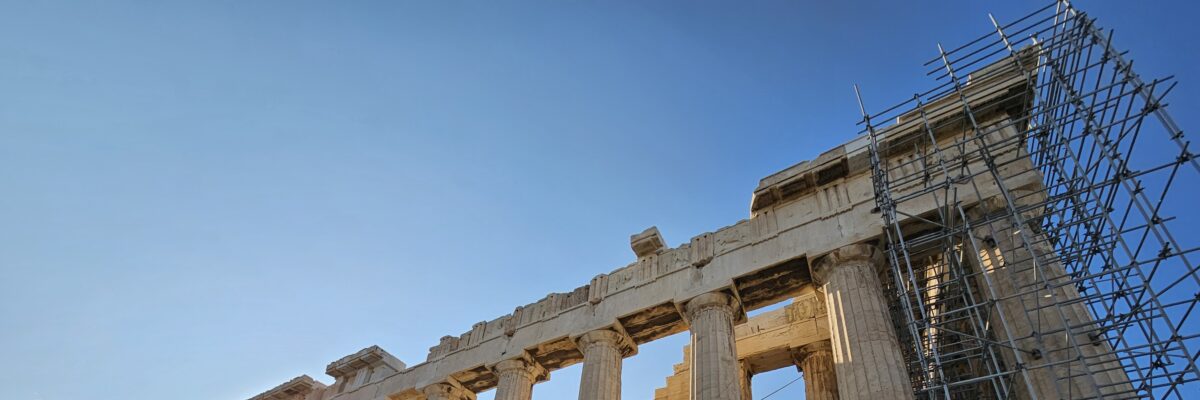
Athens is the oldest capital city in Europe and is the heart of ancient Greece.
One myth buster about Athens, the city never actually held the ancient Olympic games. It held the first modern Olympic games in 1896.
Athens was the first European capital city to be awarded the European Capital of Culture which celebrates richness and diversity of culture.
Athens set a precedent for performing arts by being the place to hold the first every plays. There are over 150 theatres in the city.
18 million tourists visit every year which is roughly six times the population.
Acropolis
Here is one of the most famous attractions outside of the wonders of the world.
The Acropolis is an ancient citadel located above Athens. It contains the remains of several ancient buildings of historical significance. The most famous being the Parthenon.
It was built to withstand earthquakes. The columns are slightly flexible and the interlocking marble blocks allow the structure to absorb and distribute seismic energy making it one of the most resilient ancient buildings.
It served as a church and a mosque under different empires. There was a hidden cave beneath the Acropolis that was once a shrine to Zeus.
Walking up to the Acropolis isn’t as bad as you’d think when you see how high it is. If you’re staying central it doesn’t take long to walk.
Save yourself the time and pre order your ticket. Don’t do what I did and turn up 30 minutes before the Acropolis opened to buy your ticket expecting it not to be busy although it didn’t take long to get a ticket.
Unless you’re part of a group tour or have an audio guide, you won’t spend more than 2 hours here. A fair bit of that time I imagine will be dedicated to getting those Instagram shots of the Acropolis.
There are several places in the complex where you can get some good pics of the city.


Ancient Agora of Athens
The Ancient Agora of Athens is an area of ancient ruins in the northwest of the Acropolis. It’s bounded on the south by the Areopagus Hill.
The Agora was the centre of Athenian democracy where Athens’s most important political gatherings took place as well as business ones.
It brought together people from all walks of life, from litigants and jurors, to merchants and philosophers. It was a place Socrates once walked.
It attracts more than half a million visitors annually. You can pay an entrance fee to walk through the complex and explore up close, or you can walk around the outside taking photos as it’s in the open.


Mount Lycabettus
Mount Lycabettus is a limestone hill 277 metres above sea level. The summit is the highest point in Central Athens.
It’s the place to be if you want to see the best sunset views of Athens.
The hike takes 40 minutes though there’s a cable car if you don’t fancy it.
And no I didn’t fancy the hike having woken up early in Santorini to fly here, and spent the day exploring which begun to catch up on me.
If you want to bag yourself a good spot for the sunset, make sure you turn up 90 minutes – 2 hours beforehand.
I got lucky turning up just over an hour before. This is where being a solo traveller comes in handy. There were still some good spots front and centre. It started filling up pretty quickly afterwards.
You can see the Acropolis and the Panathinaic Olympic Stadium in view.


Panathinaic Olympic Stadium
As we mentioned earlier, the Panathinaic Olympic Stadium played host to the first modern day Olympics in 1896.
It’s the place where the Olympic flame begins its journey.
The stadium is 2,300 years old and one of the most significant historical sites in Greece.
It’s a 30 minutes to walk to the stadium from the centre of Athens. I was gutted when I arrived to Athens that Greece were playing a Davis cup tie which two time grand slam finalist Stefanos Tsitsipas was participating in, and I didn’t know it at the time.
I can imagine for a Greek playing for your country, regardless of the sport at the this historical stadium is a priceless experience.
There isn’t a whole lot you can you when you get into the stadium. Walk around the track, chill in the stands, There were people on a hot mid September day jogging and running around the track. I couldn’t comprehend jogging in the heat.
There is a museum you can visit by going through the bottom of one of the stands. It’s a small museum but worth visiting nonetheless.


Temple of Olympian Zeus
The Temple of Olympian Zeus is a colossal temple. Now in ruins, it was dedicated to “Olympian” Zeus, a name originated from his position as head of the Olympian gods.
Built in the 5th century BC, the temple is made of limestone and marble. It’s one of the largest ancient temples in the world, measuring at 115m x 110m.
The Temple has 13 columns on both sides and 6 on the two ends. Records show that a big giant golden statue of Zeus was found inside the Temple.
I walked past here on the way to the Panathinaic Olympic Stadium. It’s not too far away from the centre of Athens, but far enough to feel like you can get out of the crowded areas.
Although in an open space, there is an entry fee to pay. You can get a photo walking past, even if there was scaffolding on the temple.

Alternative Sunset Viewing Points
I know we mentioned Mount Lycabettus has the best sunset view in Athens, but there are two alternative places.
Areopagus Hill
Also known as Mars Hill, Areopagus Hill is on the north western side of the Acropolis. It once served as a high court of appeal for judicial cases in ancient Greece.
It also served as a religious centre and a place of worship for ancient residents of the city
The top of the steep rock is a popular places for locals to gather for the sunset with impressive views of the Athens landscape.
Philopappou Hill
Philopappou Hill isn’t far from the Acropolis although a further walk away from Areopagus Hill.
Amongst other things, it was once the prison of Socrates. The prison was located in a cave on the hill.
It’s less crowded than other view points. If you don’t want a long hike and enjoy your fix of nature, Philopappou Hill is a good option.
Despite being 147m high, it’s one of the easier ones to walk.


Food
When you’re in Greece, you’re going to eager to try whatever Greek food you can get your hands on.
My personal favourite Greek food is a gyros and you’ll struggle to find a better place than Street Souvlaki.
There’s several around Athens. The original one was near where I was staying and it’s usually busy. One thing I should have done and will do next time is try one of the other sauces rather than Tzatziki. I love Tzatziki as it’s traditional in a gyros but the idea of trying something different is appealing, like the feta sauce as my friend Leo from Orlando recommended when he visited Athens.
Zampano is a chic café offering modern, seasonal takes on classic dishes. They use fresh, seasonal ingredients from all around the country. They have live music though I didn’t get a chance to experience it here.
I sampled a few cafes during my time here and none of them beat Zampano. Apart from the good breakfast options, I guess being next door to my accommodation was an added incentive. I would have happily walked a distance to eat here. I couldn’t get enough of their bagels.
Klimataria is a traditional tavern with home style cooking in an old rustic style restaurant, they also host live Greek music. They’ve been open for over 70 years.
Being of Lebanese heritage, one thing I can appreciate about the Greeks is their similarity to the Lebanese with their hospitality and quality of food. Klimataria reminded me of eating out in Beirut or in one of the villages in the mountains with the service and atmosphere.


I liked Athens. It’s a cool quirky city, there’s always something to do and you’re unlikely to get bored.
The majority of the city’s attractions are in walking distance and the transport links are good around here.
If you don’t cope well with heat, Athens in September wasn’t easy to handle, never mind what it would be like in July and August.
2 or 3 days is enough to enjoy the best of what Athens has to offer, and there are some day trip opportunities.
One last tip I’ll give you is for when you book your accommodation. If you read on any website that you’ll get views of the Acropolis, please take it with a pinch of salt because you’ll be able to see the Acropolis from just about anywhere in the city.