Evora
Day trip number two in a row after Obidos, and this time it’s to the district of Alentejo and its capital, Evora. It’s an hour and a half from Lisbon by train from Sete Rios. If you are travelling on the metro in Lisbon you need to go to Jardim Zoological metro station and from there buy a train ticket from Sete Rios which is located in the same building.
Now to give you a heads up there are a lot of photos for what I have written for this blog post. It’s not that I didn’t have much to say on Evora, I just couldn’t help myself with the camera.
It might be a cliche but it is true when they say a picture is worth a thousand words. Those words always come to mind when I look back at old photos, whether they are from the good times or challenging times.
The historic centre is a 10 – 15 minute walk from Evora station. When you get to the centre the first thing you will notice is the main square Praca do Giraldo and the church, Igreja de Santo. Antao which are in the heart of the historic centre.


The centre of Evora is partially enclosed by the medieval battle city walls. Filled with narrow streets and old white buildings, the city, which is still well preserved dates back to the Roman era.
The walls, which were made to set up a defensive parameter for the military, have been classified as a national monument in Portugal since 1922 and like a lot of Evora, it is classed as a World UNESCO Heritage site.
The city walls aren’t like the ones in Obidos or those which you actually walk on and look at views. The city walls is basically divided between the centre and the outside.
If you weren’t from Evora you could be forgiven for possibly assuming that the historic centre was the only thing in Evora with how much emphasis there is on the history and heritage of the place.
Although it seems most will mainly visit the centre, there is still more to be explored beyond the city walls and historic centre in Evora.


The centre itself is easy to explore. On the map you get from the tourist centre every place is numbered and all within a close proximity.
From Praca do Giraldo there is the Igreja da Graca, the Jardim Publico, the University (which had building work going on when I went past it), Igreja de Sao Francisco with the Capela dos Ossos (the Chapel of Bones) and the Roman Temple to name a number of places to see within a short distance.
Evora Cathedral is one of the more popular spots among tourists. Its real name is Basílica Sé de Nossa Senhora da Assunção which translates as Basilica Cathedral of Our Lady of Assumption. It is in the highest point of the city.
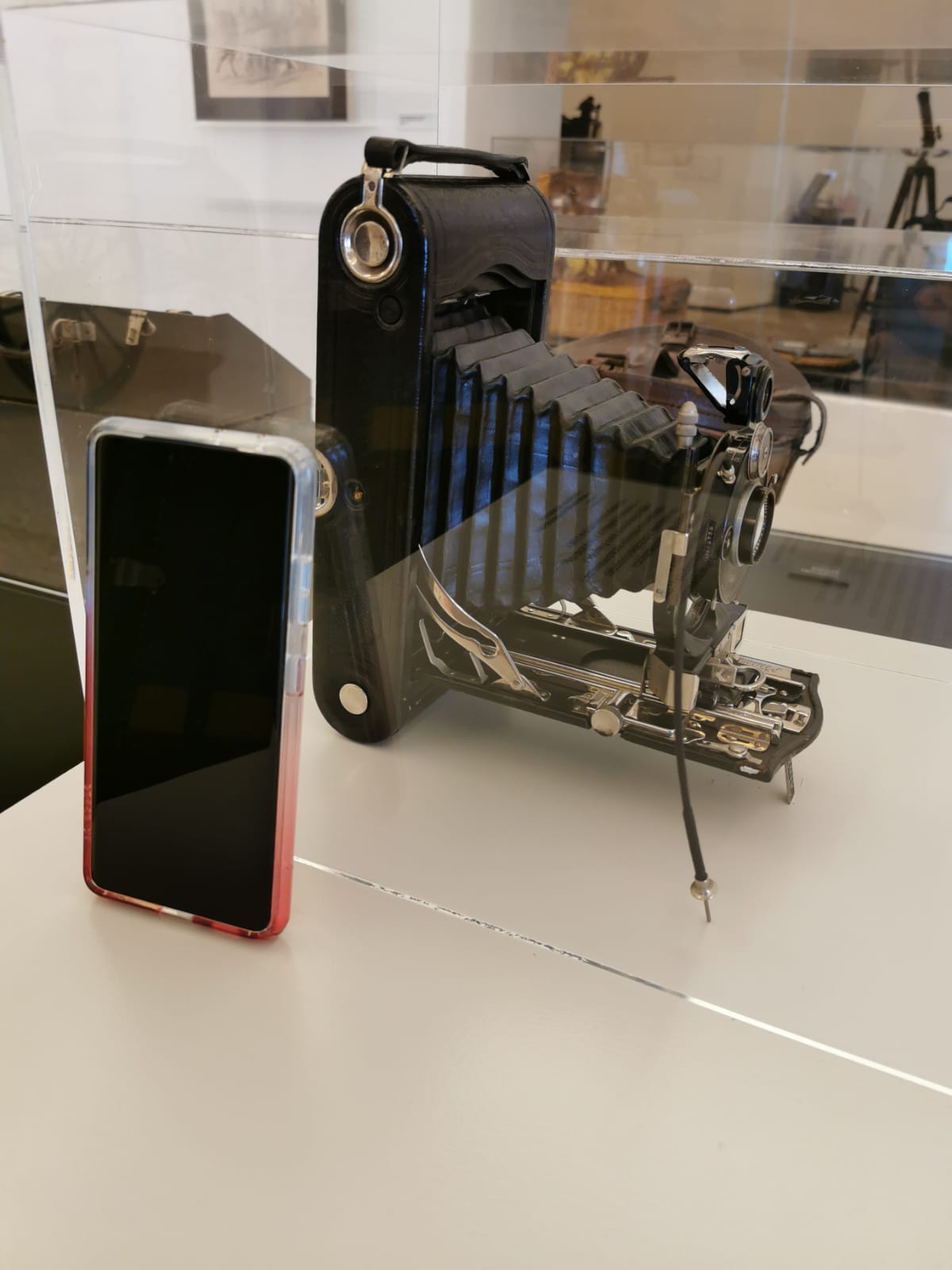
Next to the cathedral is an exhibition of old stuff used from previous centuries such as vehicles, cameras, etc. As I was taking pictures I looked at the old camera and looked at the camera on my phone, and just looking at the sheer size difference of the two, and appreciating how cameras have evolved over time from how much smaller they yet the quality in which you can take pictures.
We all know things change as they evolve with technology, but nonetheless it’s still pretty cool how the bench mark is always raised with anything from cars, cameras, televisions, laptops, smart techologies, architecture, anything infrastructure related and more.


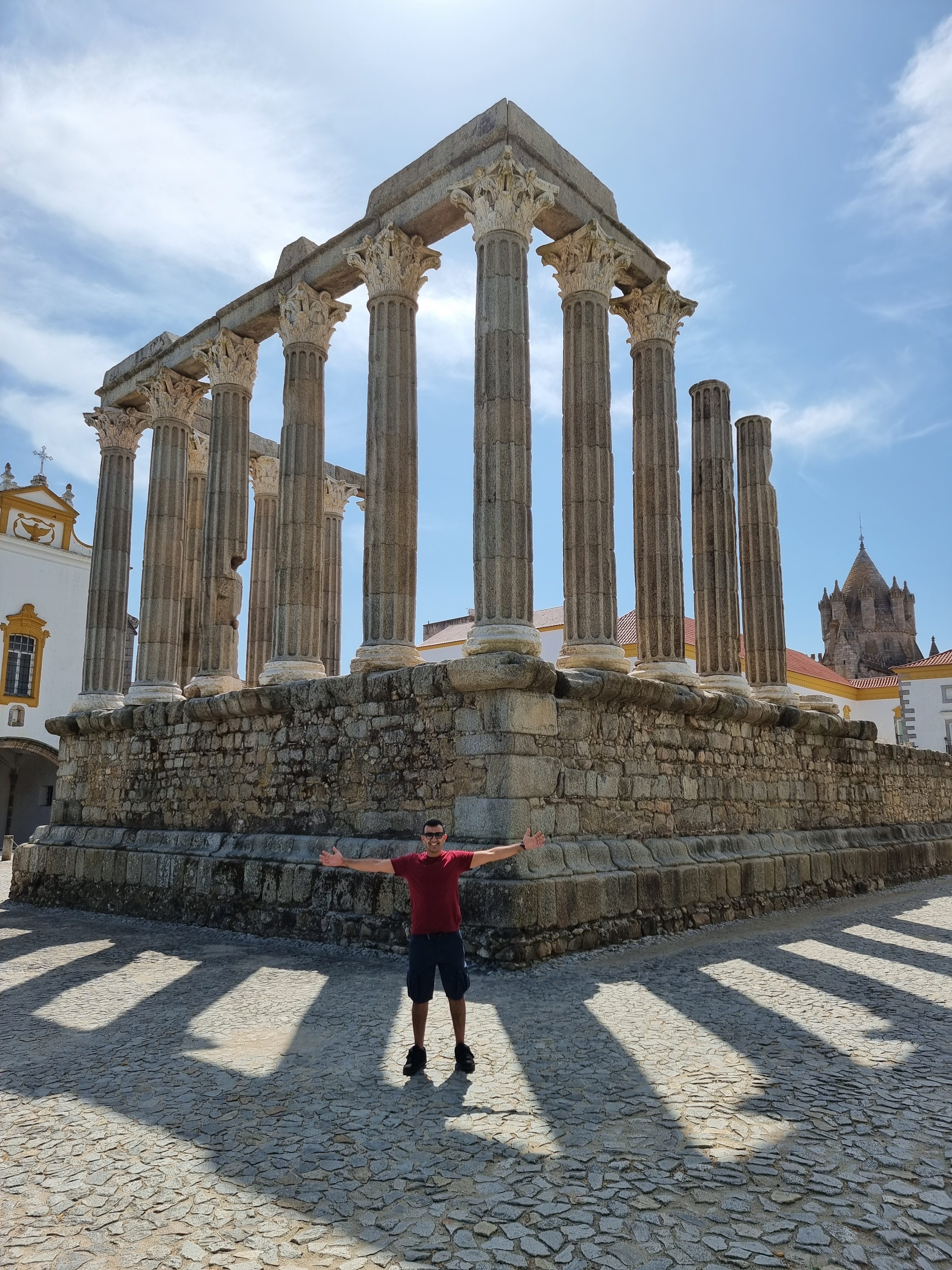
While Evora Cathedral was one of the most popular attractions to visit, the most popular by far in Evora with visitors was the Roman Temple. It is a mini version of Athen’s famous Acropolis. So if you are not able to make a trip to Greece to see one of its most iconic attractions then you have a good alternative right here.
Incorrectly known as the Diana Temple, after the goddess of the hunting due to a legend created in the 17th century associated with the construction of the Diana Temple.
In reality the Roman Temple was built as part of the roman forum dedicated to the Roman cult that worshipped the Emperor Augustus as if he were a god.
It is known as one of the best preserved Roman Temples in the Iberian Peninsula, and one of the most important landmarks in Evora. It is a symbol of the Roman occupation in the city.
There have been various uses for the temple. It has been used as a safe house. It was once used as a vault of some form for the castle of the city. At one time it was even modified to be used as a slaughterhouse. in the latter part of the 19th century it was restored to its originality with the aim of giving dignity back to the monument.
There are numerous places here to take shots, and people are likely to hang around for longer because there is a cafe nearby with a small garden, and at the end there is a place with a view of Evora. All in all it’s a nicer settings you will get herin Evora.


Seeing a Dutch couple, Susanna and Stijn trying to take photos with a decent angle, I offered to do a couple of shots for them so they could be in a picture together. As a solo traveller and someone who isn’t good at selfies (although I’m working on my selfie game), I tend to ask and rely on people to take pictures for me. So of course I like to do the good deed of doing the same, especially for families or couples because it always seems unfortunate, especially with family photos when one member misses out on being in the picture as they’re the one taking the photo. Whereas with couples though it’s nice to offer to take pictures for them, although some are content with taking selfies.
I got talking with Susanna and Stijn as we walked and took in the view of Evora, and made our way to the outdoor cafe. The day before they cycled 110km to Evora. Fair play to them for their commitment, I can’t imagine how much they were feeling it in their legs. No wonder they were taking it easy.
There is not a chance in hell I would contemplate trying to cycle that distance, but hey each to their own. No wonder Stijn wanted a beer when it wasn’t even lunchtime! After a few goes of persuading me I decided to join him and Susanna for a cider. I guess there are no rules for what time it is acceptable to drink when you are on holiday. Saying that, I don’t think there is such a thing in the UK anyway!
It was nice to chill with a cider having been on the move since early hours and on a second day trip in as many days, and chat travel and life interests with people from a different place with a different culture. I think this is an underrated thing as far as travelling goes.
Susanna and Stijn, thank you for your company and for taking pictures for me in front of the Roman Temple. I hope your legs weren’t hurting too much and you are continuing to enjoy your trip.


Another important monument in Evora’s history is the aqueducts. The aqueducts stretches to nearly 20kms connecting to a series of tunnels, arches and fountains, and supplied clean drinking water from the river Ribeira do Divor unassisted (impressively) to the population of Evora and via other nearby rivers up to 9kms to the north.
After construction finished in 1537, the inauguration of the aqueducts was held in the presence of King João III and his court in Praca do Giraldo, where a marble fountain with lions was built.
The majority of the 5 years it took to build was spent on the final few kilometers of the aqueduct,
Providing water to the people of Evora since ancient times, it has been considered a Portuguese National monument since 1910.
Aqueducts might not seem a big thing to any of you, but having seen the one in Obidos and now Evora, I have to say thinking about it, it’s an impressive bit of engineering getting the grand stone arches in place. The highest of Evora’s aqueduct arches is 26m high and spans one of the main roads into the city.


Having tried something traditional in Obidos the day before in the form of a shot of ginja in the edible chocolate shot cup, I wanted to try something traditional to Alentejo. The guy at the tourist office recommended a restaurant called Docas. He said it was authentic and not one overrun with tourists.
The waitress recommended a dish called migas alentjanas which is a bred stew according to the menu though the waitress said it was pork which was cooked then fried, and came with fried bread.
When it came out it didn’t have any sort of sauce like you would get with stew usually. Not that I was complaining or anything but I guess this is how they do it in Portugal. The look of the fried bread reminded me of a battered sausage.
If any Portuguese natives or anyone who knows Portuguese dishes are reading this, please feel free to fill me in or correct me.
I don’t know if it is just me or if anyone else can relate, but even with foods I wouldn’t usually eat I am more inclined to try most things when I travel abroad for the sake of getting the authentic feel and experience.

As always, it was good to get a taste of traditional Alentejo, and to get a feel of traditional food from new places we visit.
A short walk and an ice cream later, the day trip was done. The weird thing is I spent more time here than I did in Obidos yet it felt like I spent less time here compared to Obidos. It’s not to say I enjoyed Obidos or Evora more than the other as they’re different places from each other all together.
Evora leans more towards being like other old cities in Portugal rather than having a unique feel, prescence and vibe that you will get in Obidos.

Evora reminds me of a smaller version of Braga, with a few hills added in the centre. Another place that’s good for a day trip though there are places to explore outside the centre such as the Almendres Cromlech which are the neolithic monument of standing stones.
For this you will need a car or a taxi as there isn’t much public transport. People visiting also tend to stay a couple of days so you have options depending on how you prefer to explore.
And that’s not all, Evora might be the capital of Alentejo but there is more of the region to see.
The location of Alentejo is popular for several reasons. Apart from the places within the region to visit, there it is also the ease of getting to and from the Algarve region, and to the Spanish border so bare this in mind if you want to plan an Iberian itinerary.